 Laftel Habits
How many habits should you track at once?
Fewer than you think. Start with one to three habits you can still do on a bad day, keep them going for a few weeks, then add the next one. No study gives a number that suits everyone, but there are good reasons to start small.
What the research says, and what it doesn't
- One habit at a time. In a well-known study from University College London (Lally and colleagues, 2010), each volunteer picked one new daily behavior, such as a walk or a glass of water with lunch, and linked it to something they already did each day.
- It takes longer than a few weeks. The time until the behavior felt automatic varied a lot from person to person: from 18 days to an estimated 254, with a median of about 66 days (UCL's summary).
- One missed day is not a reset. Missing a single opportunity did not significantly affect how the habit formed. People who were very inconsistent did not form the habit.
So the research doesn't say "track exactly three". It does say a new habit needs weeks of fairly steady repetition, and that is easier to give to a few habits than to ten.
Why a short list works better
- Every habit needs a moment of attention. Ten new habits means ten things to remember, every day, before any of them runs on autopilot.
- Bad days decide it. On a good day a long list feels fine. On a sick, busy or tired day it becomes a list of misses, and a list of misses is easy to abandon.
- You learn what works. With two habits, it is easy to see which time of day, which cue and which size of habit sticks. Use that when you add the next one.
A simple way to start
- Pick one to three habits that matter to you now. Leave the rest of your improvement list for later.
- Make each one small enough for your worst day: read one page, walk around the block, stretch for two minutes. You can always do more.
- Tie each habit to a cue you already have: after your morning coffee, when you get home, before you brush your teeth.
- Check in at the same time each day, so tracking itself becomes part of the routine.
- Add one habit at a time, and only when the current ones feel easy most days.
When to add a habit, and when to shrink one
- Add when your current habits take little effort and you rarely miss them. Add one, not three.
- Shrink a habit you keep missing before you drop it: ten minutes instead of thirty, one page instead of a chapter. A small habit you keep beats a big one you skip.
- Drop a habit that no longer matters to you. Your list should be your current priorities, not a record of every resolution.
- Don't let one miss become two. Missing a day is normal. What hurts is letting a missed day turn into a missed week.
Tracking a short list with Laftel Habits
Laftel Habits is a habit tracker for Android where your habits level up a small hero, Kin. Its free version holds up to five habits, with every feature, which is plenty for starting small.
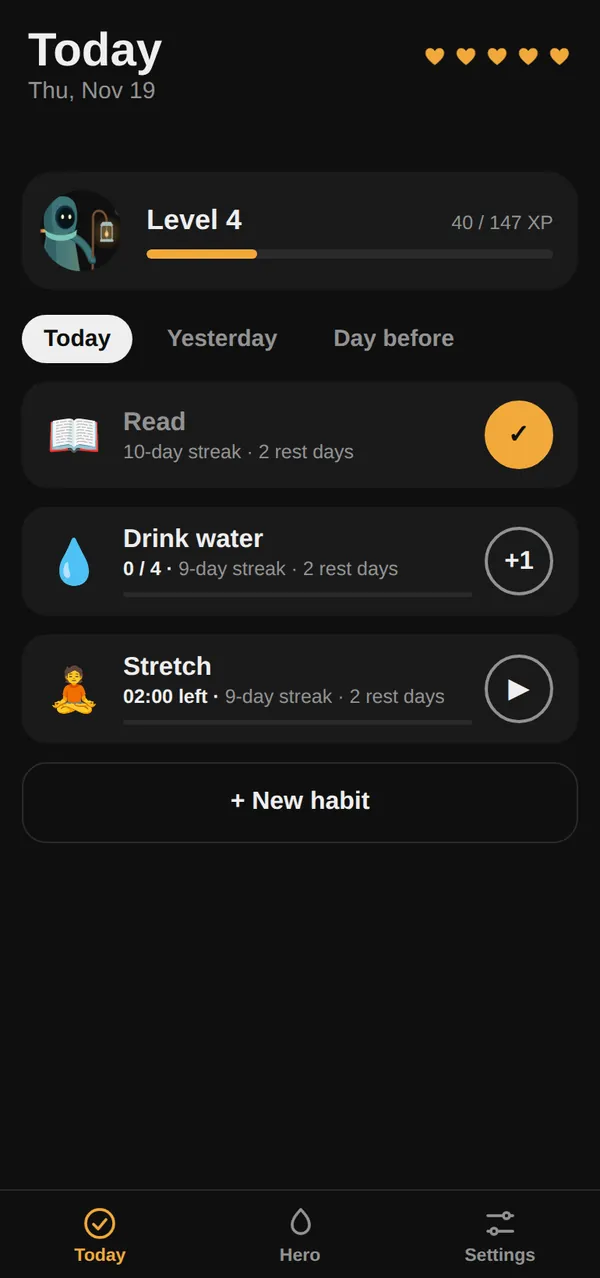
- A short list keeps your hearts. Kin has five hearts. Each habit you miss costs one, and a day with every habit done gives one back. With a list you can actually keep, the hearts stay full.
- Rest days for the odd miss. Each habit starts with one rest day and earns another for every seven days kept, with up to two banked. A banked rest day covers a missed day automatically.
- Habits that fit your worst day. A habit can be a check-off, a count (four glasses of water) or a timer (stretch for two minutes).
- Forgot to log it? You can log yesterday and the day before, and the heart comes back.
Laftel Habits works offline, with no account and no ads, and your habits stay on your phone.
Need help?
Questions about the app? Email habits@laftel.io. See also Support and the privacy policy.
Get Laftel Habits
Free for up to five habits, with every feature. One optional lifetime purchase unlocks unlimited habits and future hero cosmetics as they are released. No subscription: Google Play shows the price in your currency.